Bulk-liquid planning
One tanker down. What happens to today’s fuel dispatch plan?
We’re building an internal AI planning system for a large fuel carrier serving mining operations. Connected data and reliable feasibility checks come first. The planning engine calculates, the LLM explains, and the dispatcher makes the final allocation.
Discuss complex transport planning
Inside Bulk-liquid planning
Supplied product presentation. Demonstration data, not customer results.
- Sector
- Transport
- Story status
- Discovery / in progress
- Focus
- AI fuel dispatch planning · Mining deliveries
See the story in motion
AI for transport fuel management
Explore the fuel-management and dispatch ideas shaping this FleetPro development project.
Watch on YouTube
01 / The challenge
Start with the work,
not a feature list.
The nearest tanker isn’t always the right choice. Which site needs fuel first? Which driver meets the site requirements? Which tanker and prime mover can handle the load—and make the loading slot and delivery window? One allocation can change the entire dispatch plan.
The large fuel carrier collects from suppliers like Ampol, Mobil and Viva Energy and delivers to mining sites, including BHP and Rio Tinto operations. In that environment, proximity alone does not determine the right allocation. A driver must meet the site requirements, the tanker and prime mover must suit the load, and the combination must reach both the loading slot and delivery window. We’re building an internal planning system to bring those dependencies together while keeping operational judgement with the dispatcher.
02 / The approach
AI fuel dispatch planning · Mining deliveries
- 01Connect demand and resources
- 02Calculate feasible combinations
- 03Explore what-if scenarios
- 04Explain options
- 05Dispatcher allocation
Proposed process visual — not a deployed customer workflow.
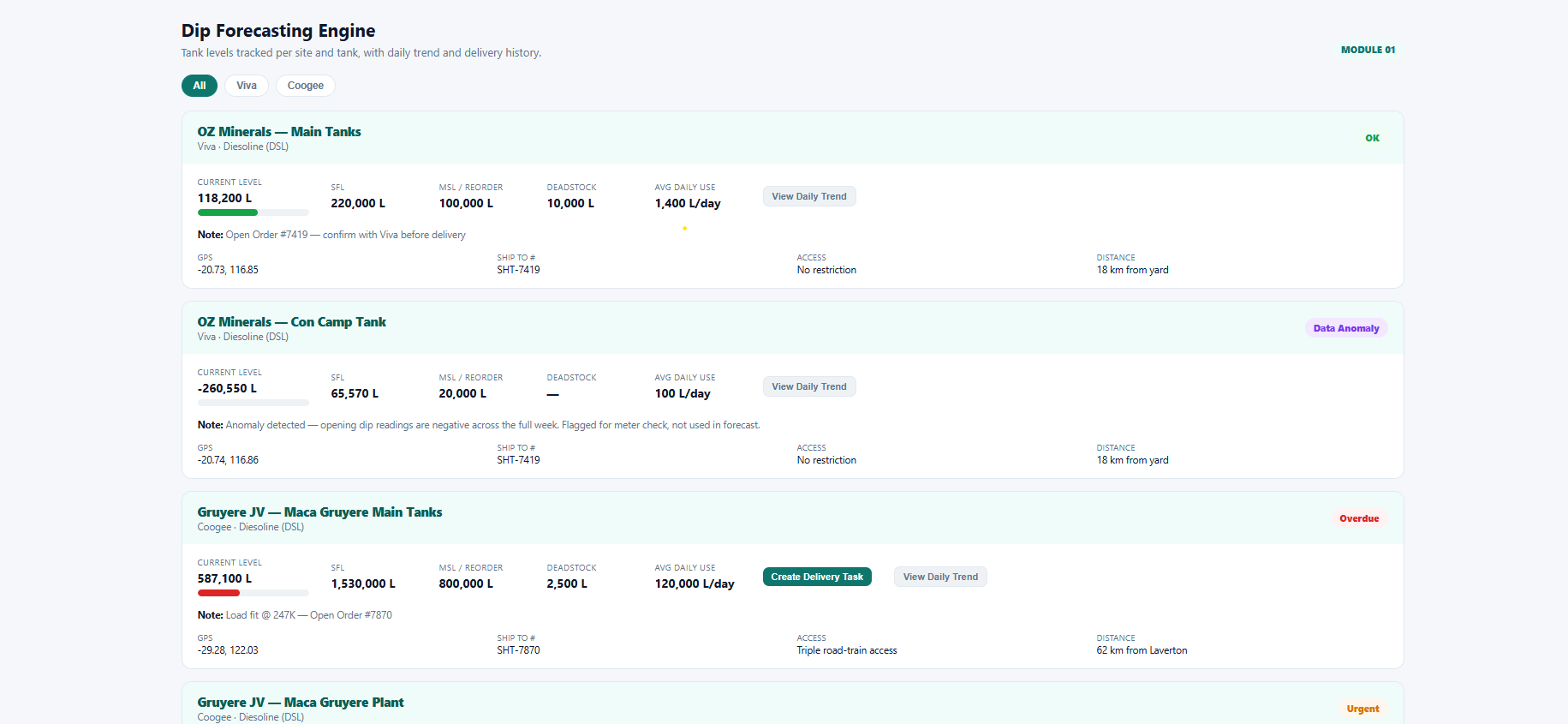
Start with the dip-forecasting picture. The supplied configuration prototype brings tank levels, reorder thresholds, daily consumption and delivery history into one view. Urgent replenishment needs and anomalous readings are surfaced for review before they shape a delivery task.
Connect demand to the weekly delivery plan. The supplied planning screen links deliveries with driver and vehicle combinations, showing work alongside workshop slots, rest breaks and fatigue indicators. The next step is to validate the operational checks against the carrier’s requirements.
Build towards connected scenario planning. Gearbox, MTData and Xero integrations are in development. Reliable demand and resource inputs form the foundation for tanker-unavailable scenarios and multi-delivery optimisation, with the planning engine calculating, the LLM explaining and the dispatcher allocating.
The system being built
Three layers. Calculations first. Explanations second.
The system we’re designing separates connected data, operational feasibility and what-if explanations. The planning engine handles calculations and feasibility checks. The LLM explains the options. The dispatcher makes the final allocation.
01 / Connect the operational data
Connect fuel demand, driver rosters, qualifications and equipment availability. Bring site requirements, load details, loading slots and delivery windows into the planning context so allocation starts with the information the job actually needs.
Output: a connected view of demand and resources
02 / Check feasible combinations
The planning engine calculates which driver, tanker and prime-mover combinations are operationally possible. It checks the relevant requirements and timing constraints; the LLM does not replace these calculations or decide feasibility.
Output: operationally feasible options for review
03 / Explore “what if?”
Let the dispatcher ask: “If this tanker becomes unavailable, what happens to today’s plan?” The planning engine evaluates the changed scenario, the LLM explains the options and knock-on effects, and the dispatcher makes the final allocation.
Output: explained scenarios and dispatcher-led decisions
Integrations in development
- Gearbox
- Planned maintenance and equipment-readiness context, subject to available records, access and agreed scope.
- MTData
- Planned vehicle and telematics context, subject to permissions, supported data and freshness checks.
- Xero
- Planned accounting handover for authorised users; exact records, approvals and synchronisation scope require validation.
The product in practice
A closer look at the workflow.
Supplied product visuals show the capabilities discussed in this story. Screen counts are demonstration data, not measured business results.
03 / The operational opportunity
Help dispatchers understand which combinations are possible—and what changes when a tanker becomes unavailable.
See replenishment priorities sooner
The dip-forecasting prototype displays current levels, reorder thresholds, daily use and delivery history, with urgent tanks and data anomalies highlighted for review.
Bring deliveries and resources together
The weekly delivery-plan prototype places tasks alongside driver and vehicle combinations, workshop schedules, rest breaks and fatigue indicators.
See the knock-on effects
The system is being designed to explore how losing a tanker changes today’s plan, not simply suggest the closest replacement.
Keep allocation with the dispatcher
The planning engine handles calculations and feasibility checks. The LLM explains the options. The dispatcher makes the final allocation.
Build towards multi-delivery optimisation
Connected demand, dependable checks and scenario planning form the foundation for the next stage: optimisation across multiple deliveries.
What to measure next.
These are review questions for evaluating the workflow, not achieved KPIs. Baselines and measured outcomes have not been supplied for publication.
- Planning inputs
- Are demand, rosters, qualifications and equipment availability complete enough to check the job?
- Operational feasibility
- Can the combination meet the site requirements, loading slot and delivery window?
- Disruption visibility
- When a tanker becomes unavailable, can the dispatcher understand the effects on today’s plan?
04 / Project summary
From tank levels to a workable delivery plan.
We’re configuring FleetPro around a large fuel carrier’s mining-delivery workflow, connecting the question “Which tank needs fuel next?” with “Which driver and vehicle combination can deliver it?”
The dip-forecasting and weekly delivery-planning prototypes make the work tangible: replenishment priorities, resource combinations, workshop schedules and rest breaks in a shared planning picture.
The development roadmap connects these modules with Gearbox, MTData and Xero, then extends the planning engine into disruption scenarios and multi-delivery optimisation. The dispatcher stays in control of allocations.
Explore a similar workflow
From this story to your next step.


A similar challenge?
Let’s talk about your workflow.
Work with our Adelaide-based team to identify the information, decisions and handovers your software needs to support.